
Where the charger has to share the house with solar and a battery
EV Charger Installation in Point Cook
Point Cook has the highest concentration of electric vehicles we see anywhere in the west, and it also has the highest concentration of rooftop solar. That combination makes it the suburb where we most often install the full stack: panels already up, a battery going in, and a charger that has to coexist with both.
- Point Cook 3030
- Powercor network
- REC 37223
The short answer
EV charger installation in Point Cook costs $1,200 to $2,200 for a single phase 7kW unit, and a 7.4kW charger adds roughly 40 to 50km of range per hour. Point Cook estate homes have modern compliant switchboards, so the question is spare capacity rather than safety. With very high EV ownership and solar already on most roofs, the real design work here is load management between the charger, the battery and a double storey home already running ducted.
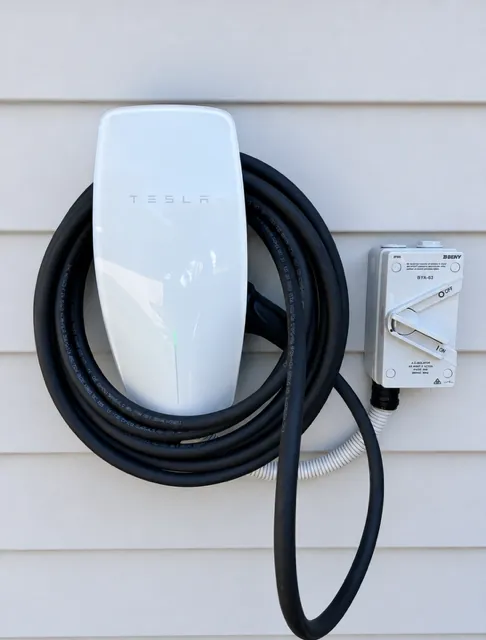
From one of our jobs
A Tesla Wall Connector on its own dedicated circuit
Photographed on site in Melbourne’s west. REC 37223.
The physical install is usually easy. Estate homes from the early 2000s onward have attached double garages, the switchboard is frequently on the garage wall itself, and the cable run is measured in metres rather than tens of metres. The design is where the thinking goes.
The board is modern, so capacity is the question
Unlike Altona or Werribee, we almost never condemn a Point Cook switchboard. Estate boards built from 2003 onward have breakers, RCDs and usually a spare way or two. The safety conversation is short.
The capacity conversation is not. A typical Point Cook home already carries ducted reverse cycle, an electric oven and cooktop, a heat pump or electric hot water service, and in a growing number of homes a battery inverter. Adding 32A of continuous charging on a single phase supply can take total demand past what the main switch and consumer mains were designed for. We calculate the maximum demand rather than guessing.
Spare way check
Most estate boards have room. If not, a subboard in the garage is often cheaper than replacing the main board.
Maximum demand
Calculated against the actual appliance list, not a rule of thumb. This is what decides whether load management is needed.
Load management
A $200 to $600 device that throttles the charger when the house is drawing hard, instead of tripping the main switch.
Charging from solar, and charging from a battery
With solar already installed, a smart charger with a current transformer on the main supply can put surplus generation into the car rather than exporting it for a few cents. On a Point Cook roof with 6.6kW or more, midday surplus is often 3 to 5kW, which is real charging.
Where there is also a battery, the priorities have to be set deliberately or the three systems fight each other. Left alone, a battery will happily discharge into the car overnight, which achieves nothing except cycling the battery. We configure the charger to take surplus solar during the day and to draw from the grid on an off peak schedule overnight, leaving the battery to cover the house in the evening peak.
Double storey homes and where the cable goes
Point Cook has a lot of double storey estate homes with narrow side setbacks and limited eaves. Where the board is in the garage, none of that matters. Where the board is on the far side of the house, the run has to get there, and the modern hip and valley roof structure with short unbroken runs makes a roof space route slower than it looks from the street.
We walk the route at the quote. In most cases the answer is a run through the garage ceiling or along an internal wall cavity, which is clean and quick. Occasionally the honest answer is surface conduit down a side wall, and we will show you exactly where it will sit before you agree to it.
Three phase in the estates, and why it is uncommon
Almost every Point Cook estate home was built single phase on the Powercor network. That means the practical charging ceiling is 32A, about 7.4kW, giving 40 to 50km of range per hour. For a household doing 50km a day that is a two hour top up, not an overnight problem.
People ask about 22kW because it appears on the spec sheets. Getting there in a Point Cook estate means a distributor supply upgrade, new consumer mains and a new board, and most cars cap their onboard AC charging at 7kW or 11kW anyway. If you have two EVs and both need full charges nightly, it can be worth the conversation. Otherwise it is not, and we will say so.
The better spend for a two EV Point Cook household is usually a second charger with dynamic load sharing between the two units. They split whatever current the supply can spare, automatically, without either car waiting for the other and without touching the incoming supply. It is a fraction of the cost of a phase conversion and it works on the switchboard you already have.
On the ground
Point Cook specifics
- Estate boards here are modern and compliant, so the honest question is spare capacity, not safety. That flips the usual quote structure: the money goes into load management and configuration rather than a board replacement.
- A high proportion of Point Cook homes already have solar, and an increasing number have a battery. Charger priorities need setting deliberately, or the battery discharges into the car overnight for no benefit.
- Attached double garages with the board on the garage wall are common, which is why Point Cook installs frequently land at the lower end of the $1,200 to $2,200 range despite the size of the houses.
- Sanctuary Lakes and the streets closer to Cheetham Wetlands take more salt than the inland Featherbrook side, so outdoor mounted units near the water still need coastal rated fixings.
Free download
The Melbourne Home EV Charger Buyer's Guide
What a charger actually costs, how to tell whether you need three phase, and the six questions that separate a real quote from a cheap one. Four pages, no email required.
PDF · 4 pages · 2026 edition
Licensed and accredited work by a local team. Read about Pivot Trade Services or see recent jobs across the western suburbs.
Answers
Point Cook questions
Set the charger to use surplus solar during daylight, and to draw grid power on an off peak schedule overnight. Leave the battery to cover the evening peak in the house. Without those priorities, the battery will discharge into the car overnight, which just adds a cycle to the battery for no saving. We configure this at commissioning and show you how to change it.
Almost certainly not without a supply upgrade. The estates were built single phase on the Powercor network, so the ceiling is about 7.4kW, or 40 to 50km of range per hour. Going to three phase means the distributor, new consumer mains and a new board, and most cars cap onboard AC charging at 7 or 11kW regardless. For a single EV household it is not worth it.
That is exactly what we calculate before quoting. A Point Cook home with ducted reverse cycle, electric cooking and hot water plus a 32A charger can approach the limit of a single phase supply on a hot evening. Where the numbers are tight we fit a load management device at $200 to $600. It monitors total demand and throttles the charger rather than tripping the main switch.
On single phase, one charger and a swapped lead handles most two car households, because both cars rarely need a full charge on the same night. If you genuinely need both plugged in nightly, two chargers with dynamic load sharing split the available current between them automatically. That is a better spend than chasing a three phase supply upgrade for a 22kW unit.
About twelve kilometres from our Altona base at Jordan Close, so it is a regular run for us rather than an occasional trip. Point Cook is one of our busiest suburbs for combined solar, battery and EV charger work, which means we usually have the parts and the configuration experience on the truck for these jobs.
Other work we do in Point Cook
- Electrician in Point CookSolar on the roof, a battery going in and a car to charge
- Solar installation in Point CookEstate roofs, EVs and second systems
- Home battery in Point CookThe suburb where the full stack happens
- Split system in Point CookDouble storey estate homes and the upstairs problem
- Heat pump hot water in Point CookAdding one more load to an already busy switchboard
Get a Point Cook quote
Tell us the address and what you need. We quote Point Cook 3030 and the surrounding western suburbs in writing, with no obligation.
- Free
- On-site quotes
- Fixed
- Written pricing
- 100%
- Workmanship guarantee
- 5.0★
- 73 Google reviews